

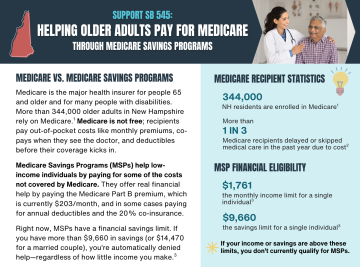
Medicare provides health insurance coverage to more than 344,000 adults ages 65+ in New Hampshire.1 But Medicare doesn't cover everything—people still pay monthly premiums, co-pays when they see the doctor, and deductibles before their coverage kicks in. For many, these out-of-pocket costs are hard to afford. New Hampshire’s Medicare Savings Programs (MSPs) help pay for these costs, but far too many low-income older adults still don’t qualify.
In 2026, New Futures and the New Hampshire Alliance for Healthy Aging are supporting SB 545 to help more older adults qualify for MSPs and afford their health care.
Take Action
Share Your Story
Have you or a family member been impacted by medical costs not covered by Medicare?
Share your story about the hidden costs of Medicare to help us show lawmakers that Granite Staters need relief.
Please consider the following questions when telling your story:
- Have you struggled to pay your Medicare Part B premium (monthly cost)?
- Have you ever delayed getting medical care because of the cost?
- Have you ever been surprised by a medical bill and struggled to pay it?
- Have medical costs impacted your ability to pay for other expenses, like groceries or housing? Have you ever had to choose between paying a medical bill or another expense?
Spread the Word: Advocacy Brief
Download and share our one-pager about Helping Older Adults Pay for Medicare Through Medicare Savings Programs
Need help? Contact Martha McLeod (Vice President of Community Engagement) for help taking action or Judith Jones (Healthy Aging Policy Director) with policy questions.
About the Bill
SB 545 has been amended to no longer remove the financial savings limit on Medicare Savings Programs (MSPs). Instead, it includes just the Medicare Extra Help piece, ensuring the connection between MSPs and the Medicare Extra Help program remains strong. This will help Granite Staters enrolled in MSPs continue to afford their prescriptions.
SB 545 would help more older adults afford their health care by removing the financial savings limit on Medicare Savings Programs (MSPs). Right now, people are denied help if they have more than $9,950 in savings (or $14,910 for a married couple)2—regardless of how little income they have.
MSPs provide real financial relief by paying for the Medicare Part B premium of $203 per month, and in some cases the annual deductibles (what you pay before Medicare kicks in) and 20% coinsurance (your portion of the bill after that) as well. For someone on a fixed income, saving $203 every month or more could mean the difference between paying for medication or the electric bill.
There's also an added benefit: automatic help with prescriptions. When people qualify for a Medicare Savings Program, they automatically qualify for federal help paying for prescriptions (called the Extra Help or Medicare LIS program)—at no extra cost to New Hampshire.
This bill will put hundreds of dollars back into the pockets of those Granite Staters who need help with monthly expenses and also help lower prescription costs.

By the Numbers: The Cost of Aging in NH
A look at the numbers show why MSPs are important for Granite Staters on fixed incomes. A single older adult in New Hampshire needs about $2,828 per month just to cover the basics: rent ($1,165), food ($324), transportation ($301), health care ($593), and other necessities ($445).3 Someone earning $1,700 a month is already short of what they need, and if they have $10,000 in savings for emergencies, they're denied help with their Medicare costs under current MSP financial eligibility rules.
Bill Status
July 7: HB 1219 became law without the Governor's signature.
May 21: The House concurred with the Senate's amendment to HB 1219.
May 14: Components of SB 545 were added as an amendment to a House Bill, HB 1219, which passed the Senate. HB 1219 now has components that strengthen the connection between Medicare Savings Programs (MSPs) and the Medicare Extra Help program.
April 23: The House of Representatives voted to defeat the bill in a 182–153 vote based on inaccurate information about the bill’s cost.
April 15: The House Health, Human Services and Elderly Affairs Committee voted 10-8 on a recommendation to not pass SB 545. However, the vote was based on inaccurate information about the bill’s cost.
April 8: The House Health, Human Services and Elderly Affairs Committee held a public hearing on SB 545.
March 26: The Senate unanimously passed SB 545 as amended in a voice vote.
March 19: The Senate Finance Committee voted unanimously to recommend passage of SB 545 with an amendment that significantly weakens the bill. Rather than removing the
savings limit, the amended bill only allows people enrolled in MSPs to automatically qualify for federal help paying for prescriptions.
February 19: The Senate unanimously passed SB 545 in a voice vote.
February 11: The Senate Health & Human Services Committee voted 4-1 on a recommendation to pass SB 545.
January 14: The Senate Health & Human Services Committee held a public hearing on SB 545.
To learn more about how a bill becomes a law, visit our About the Legislature webpage sign up for a New Futures advocacy training.
References
- KFF. (2024). Total number of Medicare beneficiaries by type of coverage. State Health Facts. Retrieved December 12, 2025 from https://www.kff.org/medicare/state-indicator/total-medicare-beneficiaries.
- New Hampshire Department of Health and Human Services, Bureau of Family Assistance. (2025, October). New Hampshire Bureau of Family Assistance (BFA) Program Fact Sheet. https://www.dhhs.nh.gov/sites/g/files/ehbemt476/files/documents2/bfa-progam-fact-sheet.pdf
- Elder Index (2024). The Elder Index™ [New Hampshire]. Boston, MA: Gerontology Institute, University of Massachusetts Boston. Retrieved December 12, 2025 from https://elderindex.org/explore.