2026 Legislative Wrap-Up
Each year from January to June, New Futures works to advance policies that improve the health and well-being of people across New Hampshire.
In 2026, we informed advocates about more than 26 priority bills, and our policy team tracked and engaged on nearly 200 additional pieces of legislation.
While the session was challenging at times, we made progress on several fronts, and there’s still important work ahead. Read through for updates on our priority bills and their current status, including next steps and how you can take action, or jump to an issue you care most about:
Scroll down to read through each bill, or jump to an issue area that you care about:
Early Childhood | Children's Behavioral Health | Health Care Access | Healthy Aging | Public Health | Substance Use Disorder | Regulation of Addictive Products
Early Childhood
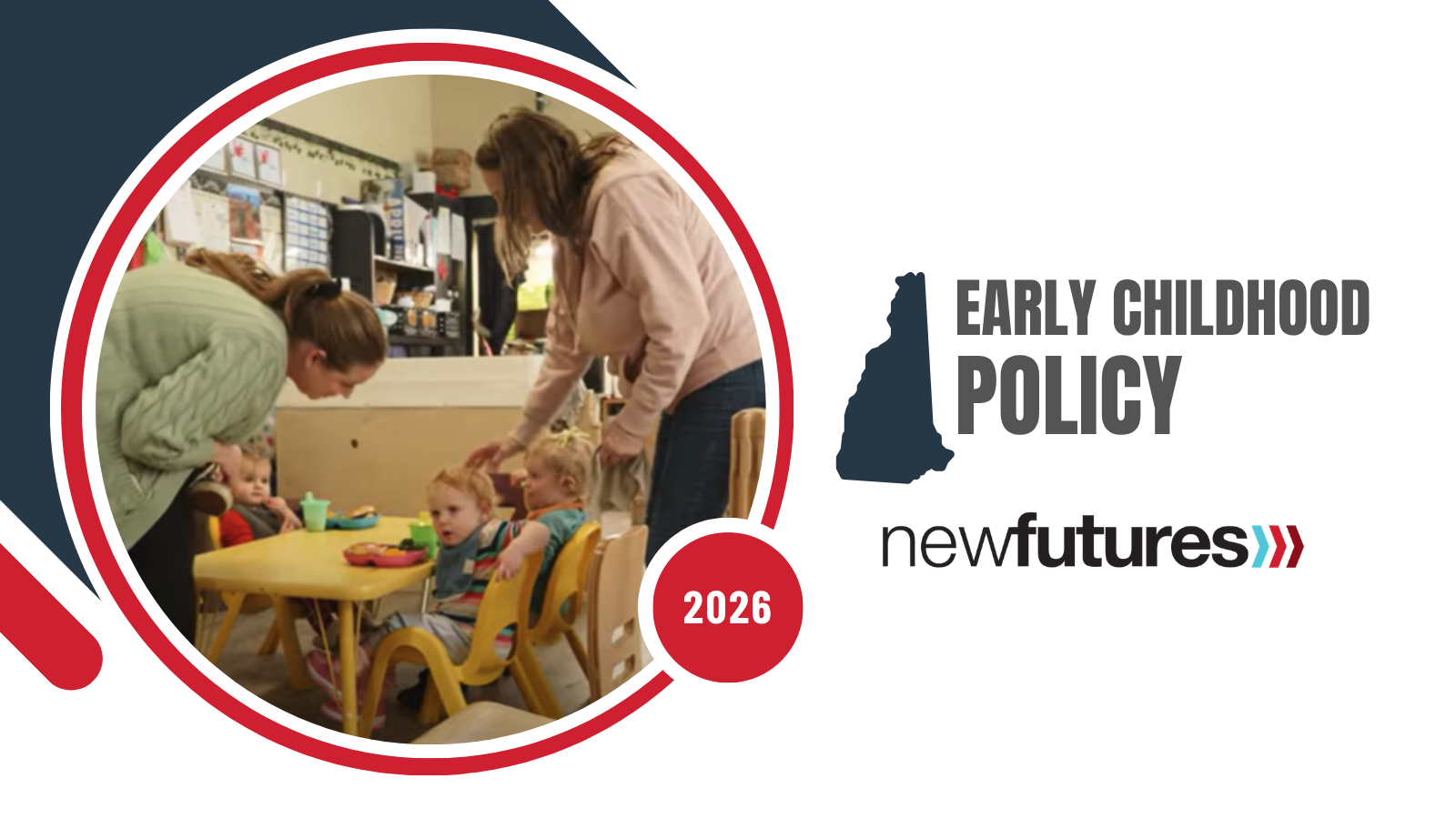
Building strong children and families is how New Hampshire builds a strong foundation for its future. Families should have access to affordable early care and education, home visiting, and family support and strengthening programs.
Our 2026 Priorities: New Futures focused on business-first solutions that expand access to quality child care in New Hampshire.
✅ Wins:
- Improving Access to Child Care: Child care is an economic challenge holding New Hampshire families back, but House Bills 1195 and 1433 would expand access to quality child care through business-first solutions. HB 1195 removes unnecessary zoning barriers that prevent family child care providers from operating in certain neighborhoods. This bill would allow more providers to enter the market and expand care options across the state. HB 1433 incentivizes businesses to create or expand child care programs through a tax credit covering 50% of eligible expenses. This enables employers to address workforce challenges by expanding access to quality child care for working families. Governor Ayotte signed both HB 1195 and HB 1433 into law on July 2. The zoning changes go into effect immediately, while the business tax credits will be available on January 1, 2027.
Children's Behavioral Health
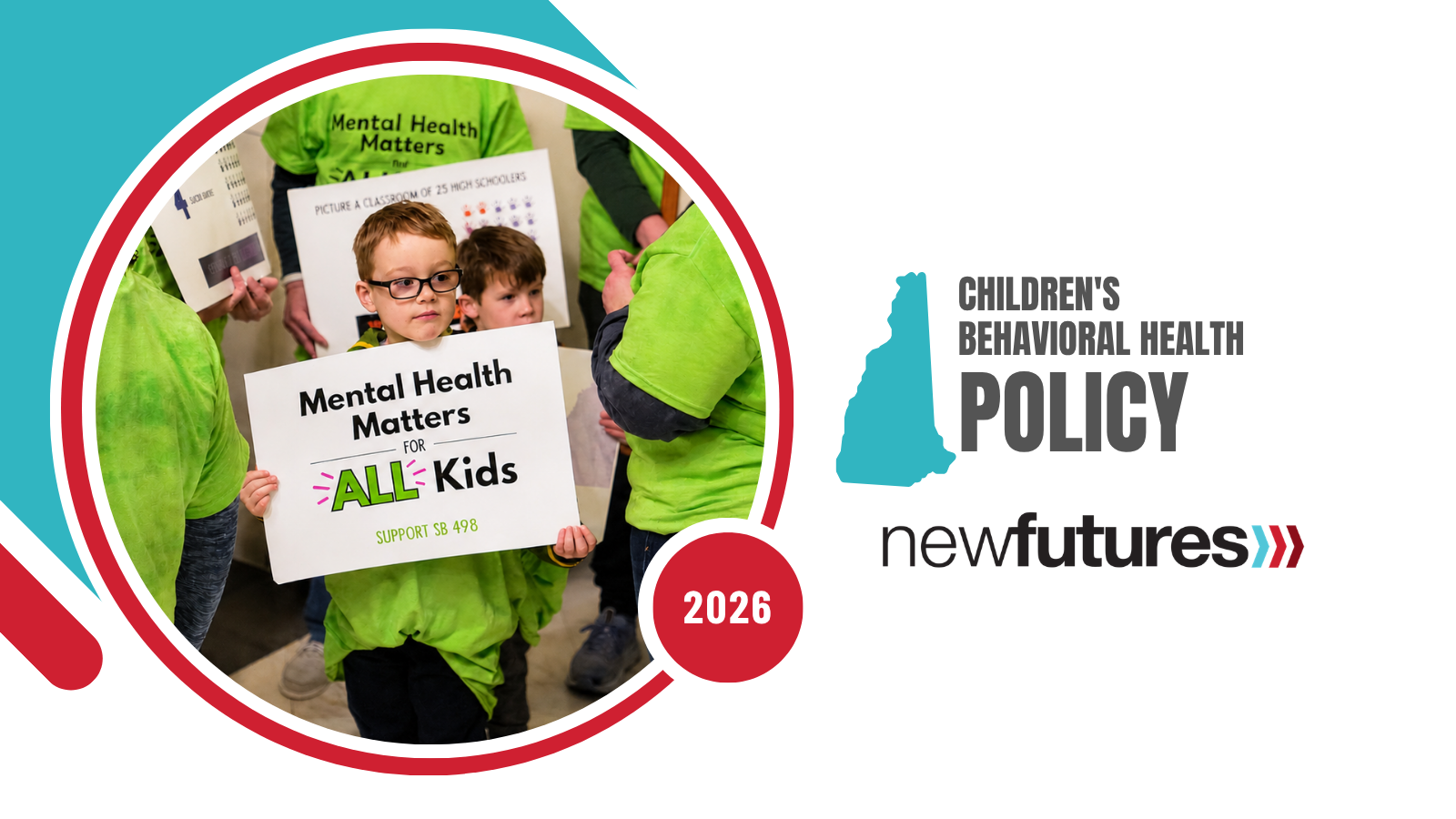
The social and emotional health of Granite State children is key to their overall health. We work to support and strengthen our state’s System of Care for children and youth who experience behavioral health challenges and ensure that programs are youth- and family-driven. Our efforts also focus on preventing harmful policies before they impact child and youth mental health.
Our 2026 Priorities: New Futures worked to support mental health services for New Hampshire children through advocating for access to comprehensive behavioral health care for all children, protecting teen voices, and defending against legislation that would make it harder for schools to provide Medicaid-covered services.
✅ Wins:
- Protecting Teen Voices and the Youth Risk Behavior Survey (YRBS): The YRBS is a completely anonymous, optional survey that allows teens to privately share their experiences so parents, schools, and communities can prevent unsafe and unhealthy behaviors. House Bill 1191 would have required families to opt-in to the survey rather than opt-out, which would significantly reduce participation and make it impossible to learn how to keep Granite State youth safe and healthy. The bill’s sponsors withdrew the bill, meaning that it did not advance past a committee hearing this session.
- Stopping Changes to MTSS-B: MTSS-B is a proven, prevention-focused framework that helps New Hampshire schools identify and support students’ behavioral health and wellness needs. This includes universal strategies that benefit all students to more intensive, individualized support for those who need it most. At a time when children’s mental health needs are at an all-time high, House Bill 1754 would have removed the statewide commitment to this evidence-based approach, leaving schools and students without critical mental health supports. Luckily, this bill was defeated in the House.
- Protecting Medicaid to Schools: New Hampshire schools provide some students with services delivered by qualified medical or behavioral health treatment professionals, often as part of Individualized Education Plans (IEPs). Some students use Medicaid for their health insurance, so schools request federal Medicaid reimbursement. Senate Bill 34 and House Bill 1640 would have made it harder for schools to bill Medicaid, potentially reducing key funding for care that students are entitled to receive. HB 1640 was defeated in the House, while SB 34 was defeated in the Senate, which rejected the House’s amendments to the bill.
❌ Setbacks:
- Establishing Coverage for Children's Behavioral Health Care Coordination: Senate Bill 498 would have closed the private health insurance coverage gap for children’s behavioral health care coordination—programs that help families navigate complex systems as they face a child's intensive behavioral health challenges. This would help all New Hampshire children get the care they need, no matter what type of insurance they have. The bill passed the Senate but faced challenges in the House Commerce and Consumer Affairs Committee, which ultimately recommended sending the bill to interim study. Attempts to overturn this recommendation on the House floor fell short. The bill text was amended by the Senate onto House Bill 1323 and sent to a Committee of Conference, but the conferees could not agree on a decision, and that bill died.
Health Care Access
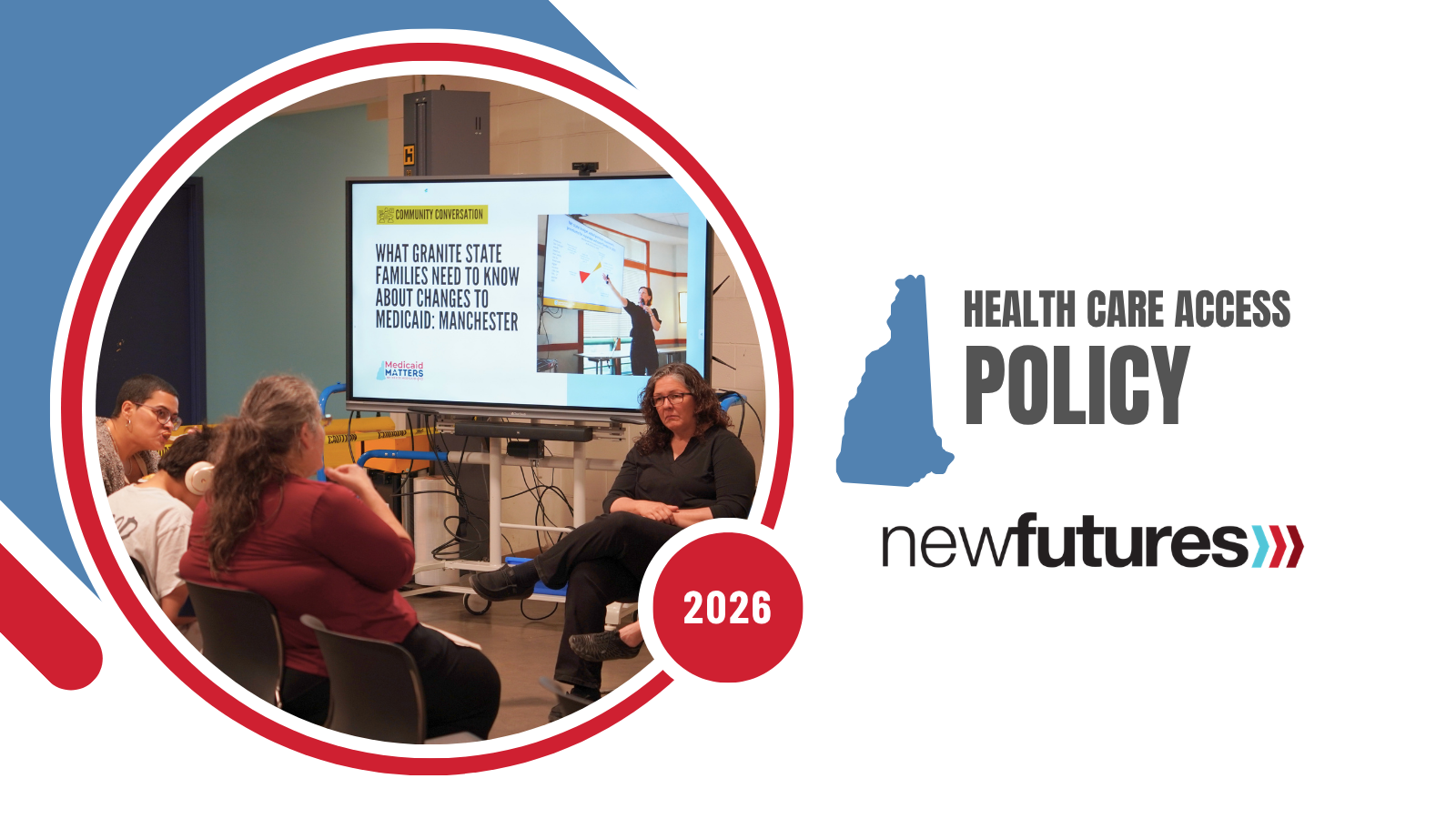
Granite Staters deserve quality, affordable health care, access to effective, evidence-based health programs, a health insurance market that focuses on consumer health, and an overall health system that aims to keep New Hampshire residents healthy.
Our 2026 Priorities: New Futures focused on making prescriptions more affordable, improving access to timely health care through adequate insurance networks, and protecting Medicaid coverage for the over 176,000 New Hampshire residents who depend on it.
Policy Outcomes:
❌ Setbacks:
-
Ensuring Access to Timely Health Care: Every Granite Stater deserves access to health care close to home when they need it, yet many face long wait times or find an in-network doctor who doesn’t have available appointments. Senate Bill 546 aimed to improve patient access to timely health care by verifying that private health insurance companies keep their provider lists up to date. Unfortunately, the Senate sent the bill to interim study after its public hearing. New Futures will continue working to ensure insurance companies meet network adequacy standards so Granite State patients can access timely care.
⏸️ Still Working:
- Supporting a No-Cost, Privacy-First Prescription Discount Card: More than half of New Hampshire residents worry about affording their prescriptions, and one in four have skipped or rationed doses due to cost. To help lower prescription costs, New Futures advanced Senate Bill 647, which would’ve offered a free prescription discount card to New Hampshire residents that saves you money without selling your personal data. Although the bill passed the Senate unanimously, it was sent to interim study in the House, stalling its progress for the session. However, New Futures has engaged with the Governor's office to identify a path forward that may include a solution, whether legislative or non-legislative. Work will continue over the summer to ensure residents can access meaningful savings at the pharmacy counter.
-
Protecting Medicaid for All: New Hampshire Medicaid provides health insurance coverage to over 176,000 Granite Staters, including children, pregnant women, people with disabilities, older adults, veterans, and working adults. New Futures continues to partner with the NH Medicaid Matters coalition to ensure that upcoming changes to our Medicaid programs don’t cause our residents to lose their essential health care coverage. New Futures staff have worked hard to develop materials around the changes and host in-person community conversations, virtual webinars, and other events to spread the word throughout the state. Stay informed and learn how you can get involved as we approach next year’s state budget cycle at nhneedsmedicaid.com.
Healthy Aging
All Granite Staters should have access to the services they need and the ability to choose where and how they age in New Hampshire. New Futures works to address the unique needs of older adults and ensure that New Hampshire supports all of us as we age.
Our 2026 Priorities: New Futures championed initiatives to promote healthy aging across the state by increasing support for caregivers, improving the affordability of health care, protecting access to emergency assistance, and maintaining funding for our senior volunteer programs.
Policy Outcomes:
✅ Wins:
-
Supporting Family and Kinship Caregivers: Family caregivers are the invisible backbone of New Hampshire's care system, providing essential support to older adults and raising children, yet they often lack the resources they need to sustain this critical work. Signed into law in late May, Senate Bill 608 provides support services such as counseling, education, and training for family caregivers assisting individuals in certain Medicaid waiver programs, and improves access to affordable child care for grandparents and other relatives raising children. The new law will go into effect after review by the Joint Legislative Fiscal Committee.
-
Helping Older Adults Afford Medicare Through Medicare Savings Programs: New Hampshire's Medicare Savings Programs (MSPs) help pay for health care costs not covered by Medicare, such as monthly premiums and co-pays when you see a doctor. Senate Bill 545 initially sought to remove the financial savings limit on MSPs, but it was amended to simply strengthen the connection between MSPs and the Medicare Extra Help program, which assists Granite Staters 65+ with prescription costs. Although SB 545 was defeated in the House due to inaccurate cost concerns, its components were added as an amendment to House Bill 1219. This bill went to the Governor's desk and became law without signature.
❌ Setbacks:
-
Protecting Access to Local Emergency Assistance: Local welfare is the last resort safety net for New Hampshire residents facing crisis, helping provide emergency shelter, food, and medicine when all other options are exhausted. Signed into law in May, House Bill 348 adds a residency requirement that will make it harder for residents in crisis to get help—not because they don't qualify, but because they can't pull together the paperwork to prove it. Through strong advocacy, the bill was amended throughout the session to soften its impact, but the barrier remains a concern.
⏸️ Still Working:
-
Maintain Senior Volunteer Programs: New Hampshire’s Retired Senior Volunteer Program (RSVP) connects adults 55+ with meaningful service opportunities across the state. Volunteers tutor children, help isolated neighbors with daily tasks, and provide older adults with transportation to medical appointments. House Bill 704, which would secure funding for our state’s RSVP, was retained during the 2025 session. This year, it was passed by the Senate only to be tabled for further review when additional revenue information is available. If the bill is not taken up before the 2026 session ends, it will die.
Public Health
Protecting New Hampshire’s public health system is critical to ensuring Granite Staters have every opportunity to start healthy and stay healthy. Public health policies prevent diseases, protect Granite Staters, and increase public awareness and education.
Our 2026 Priorities: New Futures fought against attempts to weaken access to immunizations for New Hampshire families, as well as legislation that tried to loosen immunization requirements in schools and child care centers.
✅ Wins:
- Defeated Changes to Immunization Requirements: New Hampshire law requires that all children enrolled in any school, preschool, or licensed child care facility have certain immunizations to protect them and those around them from preventable diseases. Certain exemptions are allowed for families. New Futures worked to defeat or weaken several bills aiming to change immunization requirements, including:
- House Bill 1811 would have completely repealed all childhood immunization requirements for school and child care attendance in New Hampshire. Not only would this have exposed New Hampshire’s youngest children to measles and other preventable, dangerous diseases, but it would have also jeopardized $40 million annually in federal funding for child care scholarships. The House of Representatives voted to kill HB 1811, 192-155, on February 19.
- House Bill 1616 would have banned state agencies and local governments from advertising vaccines or spending any money on vaccine education, silencing the state’s ability to communicate with families about vaccine-preventable diseases during outbreaks or to provide educational resources to health care providers. This bill was laid on the table in the House. It will not advance.
- House Bill 1719 would have removed Hepatitis B from the list of vaccines required for children to attend school or child care. Removing one vaccine at a time sets a dangerous precedent that invites future bills to remove additional vaccines. An increase in Hepatitis B outbreaks requiring emergency response could cost the state $100,000 to $350,000 per outbreak. The Senate voted to send House Bill 1719 to interim study. The House added the bill’s language to Senate Bill 625 and sent it to a Committee of Conference, where it was formally defeated.
- House Bill 1449 would have banned vaccine clinics from operating at schools during school hours and would have required a parent or guardian to be physically present. This creates significant barriers for working families and could reduce vaccination rates by making it harder for many parents to access convenient, no-cost vaccine clinics. The bill originally passed the House and was amended in the Senate. The House voted to non-concur with the Senate’s changes to defeat the bill for the year.
- House Bill 1584 originally would have required the Department of Health and Human Services to prominently display notice that exemptions are available under New Hampshire law on all vaccine-related communications and materials. It was amended to instead require DHHS to include a statement noting that medical and religious exceptions are available on materials distributed during school and child care enrollment only. These changes were approved in a Committee of Conference, and the bill is heading to Governor Ayotte.
- House Bill 524, a retained bill from last year, was a significant threat aiming to end our state’s current system for providing access to vaccines for children by eliminating the central fund that buys vaccines at a discount and offers them at no cost to New Hampshire children. This bill was amended by the House of Representatives to create a study committee to explore the effectiveness of the NHVA. It was then further amended by the Senate to set a clear deadline for how the New Hampshire Vaccine Association handles the money it collects, requiring the association to put those funds to use each year rather than letting them sit unused, and to let any money not spent on childhood vaccines be returned so it can be redirected. The House concurred with this amendment, and Governor Ayotte signed the bill into law on June 19.
Substance Use Disorder
Policies that support evidence-based prevention, treatment, and recovery programs are crucial to ensure that every New Hampshire resident is a healthy member of our society.
Our 2026 Priorities: New Futures worked to address New Hampshire's substance use disorder crisis by expanding access to recovery housing and advocating for stronger patient protections and quality standards in our substance use treatment system.
❌ Setbacks:
- Ensuring Recovery Homes are Safe and Effective: Recovery housing provides safe, stable living environments that support those in our communities who are in recovery from substance use disorder. Senate Bill 298 would’ve protected residents and communities by ensuring that all recovery houses meet established health and safety standards. Unfortunately, this retained bill from 2025 was amended in the House to turn the bill into a study committee, and the Senate voted to non-concur with the amendment. This stalled the bill for the session.
- Oversight of the Substance Use Treatment System: New Hampshire has many outpatient substance use disorder treatment providers that deliver high-quality, evidence-based care. However, without state licensing, there is no way for patients and families to know where to find safe and effective care. House Bill 751 initially sought to protect patients by ensuring these facilities are licensed. However, the House amended the bill to a mere study committee, despite the issue already having been thoroughly considered by a previous committee. Then, the Senate added an amendment with two unrelated policies relating to public schools. As the bill’s goals changed drastically, we no longer supported it. Ultimately, the bill was tabled after the conference committee was not able to come to an agreement.
Regulation of Addictive Products
Adolescent brains are uniquely vulnerable to addiction. Starting substance use before age 15 makes someone 4-6 times more likely to develop a substance use disorder. New Hampshire has strong laws protecting kids from tobacco and alcohol, but companies found legal loopholes to sell and market other highly addictive products to youth.
Our 2026 Priorities: New Futures worked to close these legal loopholes that allow for the sales of highly-addictive products like hemp-derived THC products, kratom, and nitrous oxide. New Futures also supported legislation to stop the legality of deceptive vape products.
✅ Wins:
- Regulating Hemp-Derived THC Products: Companies sell THC products by labeling them "hemp-derived" instead of "cannabis," exploiting a technicality in federal law. Hemp-derived products are already banned in New Hampshire, but Senate Bill 624 explicitly prohibits the sale of hemp-derived products containing THC greater than 0.3 percent, including specific formulations like delta-8 and delta-9 THC, and gives the Division of Liquor Enforcement the ability to penalize licensees who continue to sell these products. Governor Ayotte signed this bill into law on July 2, and it will go into effect on January 1, 2027.
- Banning Recreational Nitrous Oxide: Nitrous oxide sold for recreational inhalation has no restrictions in New Hampshire, despite documented brain damage, suffocation deaths, and targeted marketing to teens. House Bill 1630 bans the sale of nitrous oxide for recreational purposes at convenience stores, smoke shops, and other licensed liquor and tobacco vendors in New Hampshire. This bill was signed into law on June 19 and will go into effect on January 1, 2027.
❌ Setbacks:
- Banning Synthetic Kratom Sales: Synthetic kratom is an addictive opioid-like substance that has no age restrictions or safety standards in New Hampshire. Gas stations and convenience stores sell it with zero oversight. Senate Bill 557 would have made it illegal to prepare, distribute, manufacture, sell, possess, or advertise synthetic and semisynthetic kratom products. However, the House and Senate had different ideas on enforcement methods, and the bill ultimately died when the Senate did not concur with the House version of the bill. New Futures looks forward to working to compromise on this bill next session.
- Stopping Sales of Deceptive Vapes: Vaping companies disguise nicotine products as highlighters, USB drives, smartwatches, and candy to hide use from parents and teachers. House Bill 1538 prohibited marketing vapes that imitate non-vape products, use child-appealing characters, or include video game features. This bill was defeated in the House in March. New Futures looks forward to supporting similar legislation in the future.